Choosing the Right Budgeting Framework for Your Household Structure
Budgeting is often presented as a test of discipline. If the numbers do not work, the assumption is that someone must not be tracking carefully enough or spending responsibly enough.
That explanation misses something important: households operate differently.
A budgeting system that feels effortless for two people with steady salaries may become frustrating for a freelancer whose income changes every month. A parent managing frequent household purchases may need a different system from someone who rarely makes discretionary purchases. Even a simple budget can become difficult to maintain when the method itself does not fit the way money actually moves through the household.
Think of a budgeting framework as a tool rather than a rulebook. The right choice depends on income stability, spending habits, available time and the level of detail a household is willing to maintain.
Four approaches are especially common: zero-based budgeting, the envelope method, percentage-based budgeting and reverse budgeting. They solve different problems, and none is automatically the best choice for everyone.
Zero-Based Budgeting: Maximum Visibility
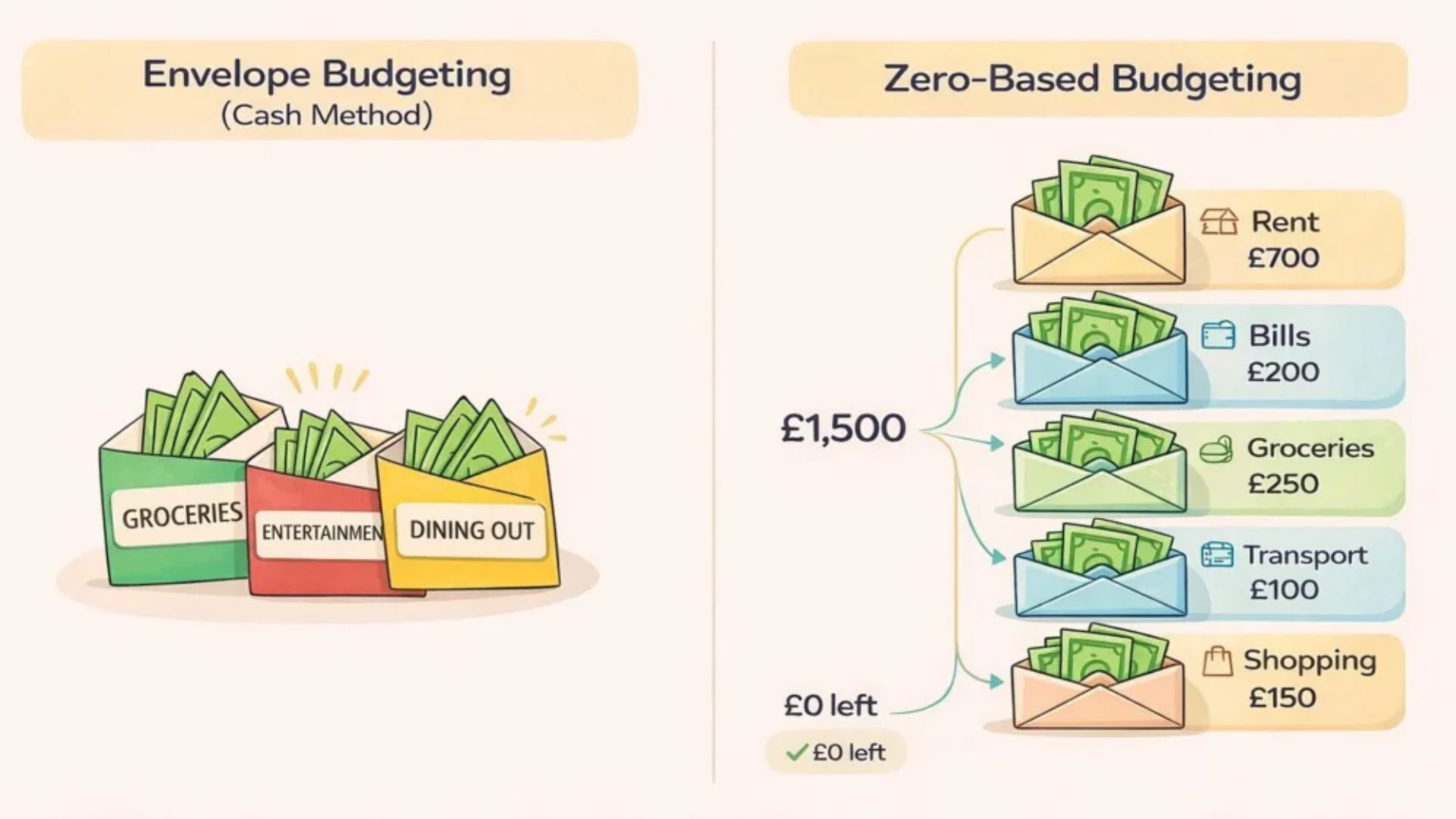
Zero-based budgeting gives every dollar of expected income a planned purpose. The objective is not necessarily to make the bank balance literally reach zero. Instead, planned income is matched with planned expenses, savings, debt payments and other financial priorities so that there is little or no unassigned money.
For example, a household expecting $5,000 of income might assign portions to housing, groceries, transportation, debt payments, savings and discretionary spending. The important part is that the entire amount has been considered before the month unfolds.
This approach can be useful when a household wants a detailed view of where its money is going. It may also appeal to people who are working toward a specific financial priority, such as reducing debt or building savings, because the system makes competing uses for the same income more visible.
The trade-off is maintenance.
A detailed budget requires regular attention. Transactions may need to be categorized, planned amounts may need adjustment, and unexpected expenses can force several categories to be reshuffled.
That does not make zero-based budgeting a bad system. It simply means the method works best when the household is willing to spend some time maintaining it.
For someone who enjoys detailed financial tracking, that precision can be helpful. For someone who already finds budgeting exhausting, the same level of detail may become the reason the system is eventually abandoned.
The Envelope Method: Putting a Boundary Around Spending
The envelope system takes a different approach. Instead of focusing primarily on assigning every dollar, it creates spending boundaries around specific categories.
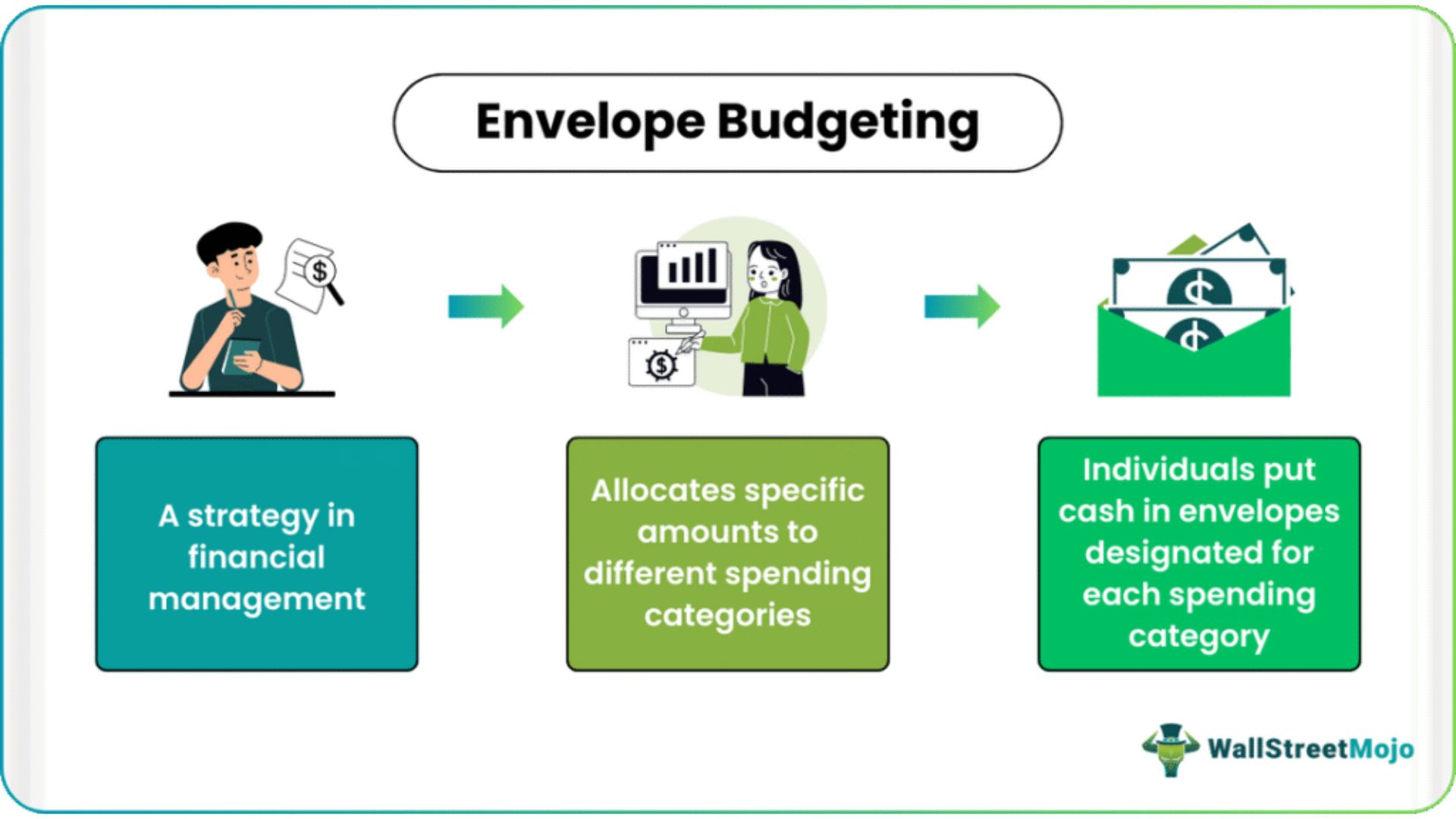
The traditional version uses physical cash. A household might place a set amount into envelopes labeled groceries, dining out, entertainment or clothing. Once the money in an envelope is gone, spending in that category pauses until the next allocation.
The modern version can use separate bank accounts, digital envelopes or savings sub-accounts instead.
The strength of the system is behavioral rather than mathematical.
A card payment can feel almost invisible. Handing over cash and watching the envelope become thinner is much harder to ignore. For someone who regularly overspends in a particular category, that physical limitation can create a useful pause.
The method can be particularly helpful when the main budgeting problem is not income calculation but discretionary spending. Someone who repeatedly spends more than planned on dining, entertainment or shopping may benefit from a system that places a visible boundary around those categories.
There are drawbacks, though.
Physical cash is inconvenient for online purchases, recurring bills, travel and many everyday transactions. Carrying large amounts of cash can also create practical and security concerns.
Digital versions solve much of that inconvenience, but they may not create the same psychological effect. Moving money between digital categories is often easier than taking cash out of a physical envelope.
The best version is therefore the one that preserves the behavioral boundary without creating unnecessary friction.
Percentage-Based Budgeting: Simpler, Broader Rules
Percentage-based budgeting works at a higher level.
Instead of deciding exactly how much should be spent on every category, income is divided among broad groups. The 50/30/20 framework is one well-known example: 50% for needs, 30% for wants and 20% for savings or other financial priorities.
The appeal is obvious. There are fewer numbers to maintain.
Someone with a busy schedule may not want to categorize every grocery purchase or restaurant bill. A broad spending framework can provide direction without requiring a detailed spreadsheet every week.
But percentage rules should be treated as guidelines, not universal financial laws.
Housing costs alone can consume a large portion of take-home income in some locations. Debt payments, childcare, insurance and transportation can create additional fixed obligations. In those circumstances, forcing every household into an identical percentage split can produce unrealistic expectations.
Imagine a household where essential expenses already account for 65% of take-home income. Telling that household that necessities "should" remain at 50% does not solve the underlying cost problem. It may simply make the budget look like a failure.
A better use of percentage budgeting is to establish broad priorities and then adjust the percentages to fit actual circumstances.
The framework can still be useful. It just needs room for reality.
Reverse Budgeting: Automating Priorities First
Reverse budgeting, sometimes called a "pay yourself first" approach, changes the order in which money is allocated.
Instead of tracking every expense and hoping something remains for savings at the end of the month, the household decides how much should go toward selected financial priorities first. Automatic transfers can then move those amounts into savings, retirement accounts or other designated destinations, subject to the household's circumstances and account setup.
The money that remains can be used for ordinary expenses.
This method appeals to people who prefer automation over detailed expense tracking. It can also be useful for households with relatively predictable financial priorities but little interest in maintaining a highly detailed budget.
For example, someone might establish automatic transfers for savings and recurring obligations shortly after receiving income. Everyday spending then takes place from the remaining balance.
The advantage is simplicity. Important allocations do not depend entirely on remembering to make them later.
The weakness is visibility.
If spending categories are not monitored at all, lifestyle creep can gradually absorb the money that remains after automatic transfers. Irregular expenses can also become a problem if they were not included in the broader plan.
That means reverse budgeting often works better with at least a few guardrails. A household might track larger variable expenses, maintain sinking funds for annual costs, or review account balances periodically without recording every individual purchase.
Automation does not have to mean complete blindness.
Which Framework Fits Which Household?
The easiest way to choose a budgeting method is to start with the problem that needs solving.
If the biggest problem is lack of visibility, zero-based budgeting may be worth considering. It provides detailed information about where expected income is going and can make trade-offs easier to see.
If overspending in a few categories is the main issue, an envelope approach may be more effective. The system creates a clear boundary around discretionary spending rather than relying entirely on self-monitoring.
If time is the biggest constraint, percentage-based budgeting can provide a simpler structure. It offers broad targets without requiring every transaction to receive its own category.
If saving consistently is the main priority, reverse budgeting can reduce the need to make the same decision every month. Automatic allocations put selected priorities earlier in the cash-flow process.
Income stability matters, too.
A household with a predictable salary may find a detailed monthly budget relatively easy to maintain. A freelancer or contractor with uneven income may need a larger cash buffer and a more flexible allocation process before choosing any particular budgeting method.
And there is no requirement to choose only one.
A household could use reverse budgeting for savings, sinking funds for irregular expenses and envelope-style limits for groceries or entertainment. Another might use percentage targets for the overall plan while tracking a few categories in detail.
The combination can be more useful than the label.
A Practical Way to Test a Budgeting Method
Instead of committing to a budgeting system indefinitely, treat the first few months as a trial.
Start by identifying the problem that prompted the search for a new system. Is spending getting out of control? Are bills being missed? Is saving inconsistent? Is the budget simply taking too much time to maintain?
That answer should guide the choice.
Then run the selected method for a few spending cycles. Pay attention not only to the numbers but also to how much effort the system requires.
A budget that looks excellent on paper but takes several hours every week may not be sustainable. Likewise, an extremely simple system may be too loose if spending repeatedly exceeds available cash.
The useful question is not, "Which budgeting method is objectively best?"
It is, "Which method gives this household enough control without creating more friction than it solves?"

Budgeting Is a Design Choice, Not a Character Test
There is no single budgeting framework that works perfectly for every household.
Zero-based budgeting provides detailed control. The envelope method creates strong behavioral boundaries. Percentage-based budgeting keeps the big picture simple. Reverse budgeting puts selected priorities on autopilot.
Each approach has strengths, and each has limitations.
The best choice is usually the one that matches the household's actual income pattern, spending behavior and tolerance for financial administration. A method that is technically sophisticated but impossible to maintain is unlikely to outperform a simpler system that gets used consistently.
Budgeting works best when it fits real life. The goal is not to track money for the sake of tracking it. The goal is to create enough structure to make spending, saving and financial decisions easier to manage over time.
This article provides general household budgeting information rather than individualized financial, tax or investment advice. Appropriate budgeting methods vary according to income, expenses, debt, savings goals and individual circumstances.
Filed under
More Stories